Why Choose a Creative Agency for Startups
Why choose a creative agency for brand identity? Explore agency types, the creative process, costs, risks, and how to select the right fit.
📆

Choosing a creative agency is one of the higher-stakes decisions a startup founder makes, and it's easy to get wrong when you're short on time and long on ambition. Creative agencies have moved well past pure design execution. The strong ones now function as strategic partners who help you figure out what to say, not just how it looks.
This guide breaks down what creative agencies actually do, the different types you'll run into, how a real engagement works from first call to final deliverable, and how to weigh an agency against the alternatives- an in-house team, a freelancer, or AI tools- so you can make a decision based on your actual constraints instead of guesswork.
What a creative agency actually does
A creative agency isn't a vendor you hand a logo brief to and wait on. The agencies worth hiring function as strategic partners who help translate a business problem into a brand people actually understand and trust. That's a different job than "make it look good," and it changes what you should expect from the relationship.
The shift over the last several years has been real. Agencies that used to be pure design shops now bring strategists, researchers, and technologists into the same room as designers and copywriters. For a tech startup specifically, that matters because your brand problem usually isn't "we need a logo"; it's "we need to explain a complicated product to people who've never heard of us in a way that makes them trust us enough to sign up."
A capable creative agency brings brand strategy, digital design, user experience mapping, market positioning, and messaging development under one roof, with a team that includes strategists and researchers alongside designers, not just designers working alone.
Pro Tip: When you're evaluating agencies, ask for one example of a project where they changed the client's strategic direction, not just the visual output. That answer tells you whether you're hiring a strategic partner or a production shop.
Types of creative agencies and what each one is built for
Not every creative agency does the same job, and picking the wrong type for your actual problem is one of the most common early mistakes founders make.
Agency Type | Core Focus | What It's Best For |
|---|---|---|
Branding Agency | Brand identity and narrative | Differentiating your business in a crowded market |
Graphic Design Studio | Visual communication assets | Sharpening the clarity of your messaging |
Digital Marketing Agency | Online campaigns and platforms | Growing digital audience reach |
Advertising Agency | Campaign concepts and messaging | Driving audience engagement at scale |
Multimedia Production | Video, motion, and content | Building immersive brand experiences |
Branding agencies build the strategic and visual foundation, positioning, naming, logo systems, and brand guidelines. Graphic design studios execute visual assets against a foundation that's usually already defined. Digital marketing agencies run the channels: campaigns, social presence, and the digital experiences that connect a brand to its audience. Advertising agencies build the concepts and messaging that carry a brand into paid and earned media. Multimedia production teams build the video and motion content that makes a brand feel alive instead of static.
Most startups need one or two of these, not all five. Knowing which one maps to your actual gap saves you from paying for services you don't need yet.
Pro Tip: When you're reviewing an agency's portfolio, look past whether the work is pretty. Look for evidence of strategic thinking and a measurable result tied to the project, not just the final screenshots.
How the creative process actually works
A structured creative process is what separates an agency from a freelancer with better branding. The engagement usually moves through a few connected stages, and understanding them upfront helps you know what to expect and when.
It starts with discovery: understanding your value proposition, your audience, your competitive landscape, and what you're actually trying to communicate. From there, the agency develops a creative brief with you, crystallizing goals and defining what success looks like before anyone opens a design file. That brief becomes the reference point for everything that follows.
Ideation comes next. Designers, strategists, and copywriters generate multiple directions, often using competitive analysis and rapid prototyping to test ideas before committing to one. Development follows, with iterative rounds where concepts get refined through structured feedback, client input, and whatever data is available to inform decisions. Each round should sharpen the work, not just change it.
Pro Tip: Ask an agency to walk you through their process during the first consultation, and pay specific attention to how they handle client feedback and how they measure whether a project succeeded. Vague answers here predict a vague working relationship later.
What a real creative partnership gets you
The value of a good creative agency isn't just the deliverables. It's the outside perspective you can't generate internally, no matter how talented your team is.
Founders who've been staring at the same problem for months develop blind spots they can't see from the inside. An outside team brings cross-industry pattern recognition: they've seen how other companies solved similar communication problems, and they bring that experience into your project instead of starting from zero. That's genuinely hard to replicate with an internal team that's only ever worked on your brand.
The practical upside compounds from there. A strong agency helps you develop a brand identity that actually resonates with your specific audience, differentiates you from direct competitors, and gives you assets you can use to attract customers, investors, and talent at the same time. That's a wider return than most founders expect when they first budget for "design."
Pro Tip: Ask for case studies from startups specifically, not just enterprise clients. The constraints of limited budget and a compressed timeline are different problems than a Fortune 500 rebrand, and you want evidence the agency has solved your specific version of the problem.
Creative agency vs. the alternatives
Every startup eventually weighs a creative agency against the other ways to get design and brand work done: an in-house hire, a freelancer, or AI-assisted tools. None of these is universally right. Each one trades cost, control, and strategic depth differently.
Option | Cost Structure | Strategic Value | Flexibility |
|---|---|---|---|
Creative Agency | Project or retainer-based | High, multidisciplinary | Moderate to high |
In-House Team | Salary and overhead | Deep brand alignment over time | Low to moderate |
Freelancer | Hourly or project fees | Strong on specific skills | High |
AI Tools | Subscription or license fee | Fast, limited strategic depth | Very high |
An in-house team gives you the deepest long-term brand alignment, since they live inside your company every day, but the overhead is real, and you're paying for capacity even in slow months. It's also not a free pass on the talent problem: research from the Association of National Advertisers found 63% of in-house creative teams struggle to keep talent energized, and 44% struggle to attract top-tier talent in the first place. Bringing design in-house doesn't automatically solve the quality problem an agency is meant to solve. Freelancers are flexible and often excellent at a specific skill, but you're assembling the strategic thinking yourself, since most freelancers execute within a brief rather than building one. AI tools are fast and cheap for narrow, well-defined tasks, but they don't replace the judgment that connects a design decision to a business outcome, at least not yet. A creative agency sits in the middle: more strategic depth than a freelancer, more flexibility than a full-time hire, and a cost structure that scales with the project instead of running year-round.
The cheapest option upfront is rarely the cheapest option once you count the cost of a brand that doesn't land, or a project that has to be redone because nobody was thinking about strategy in the first place.
Pro Tip: Score your options against cost, strategic value, turnaround time, and long-term brand impact before you decide. A simple four-column comparison forces a clearer decision than gut instinct alone.
Key takeaways
Point | Details |
|---|---|
Agencies are strategic partners now | The strong ones bring strategists and researchers alongside designers, not just visual execution. |
Match the agency type to your gap. | Branding, digital marketing, advertising, and production agencies solve different problems, not the same one. |
A structured process signals maturity. | Discovery, brief, ideation, and iterative development are what separate a real partnership from ad hoc design work. |
Outside perspective is the real value. | Agencies bring cross-industry pattern recognition an internal team can't replicate on its own. |
Weigh all four alternatives honestly. | Agencies, in-house teams, freelancers, and AI tools each trade cost, control, and strategic depth differently. |
What I've learned watching startups choose creative partners
The founders who get the most out of a creative agency are the ones who go in treating it as a strategic hire, not a design purchase. They come to the first call with a real problem statement, not just a request for "something that looks professional." That single difference changes the quality of everything the agency produces.
The mistake I see most often is founders defaulting to the cheapest option without pricing in the cost of getting it wrong. A freelancer at half the rate looks efficient until the brand identity doesn't hold up as the company scales, and you're paying for a second rebuild eighteen months later. That's not a hypothetical. I've watched it happen to founders who were trying to save money at exactly the wrong stage of the company.
The other thing worth saying plainly: agencies aren't magic. A great creative partner amplifies a clear strategic direction. They can't invent one for you out of nothing. The founders who get the best results show up with a real point of view about their business, and let the agency sharpen and express it, rather than expecting the agency to figure out who the company is from scratch.
- Arnob
Find a creative agency built for where you are
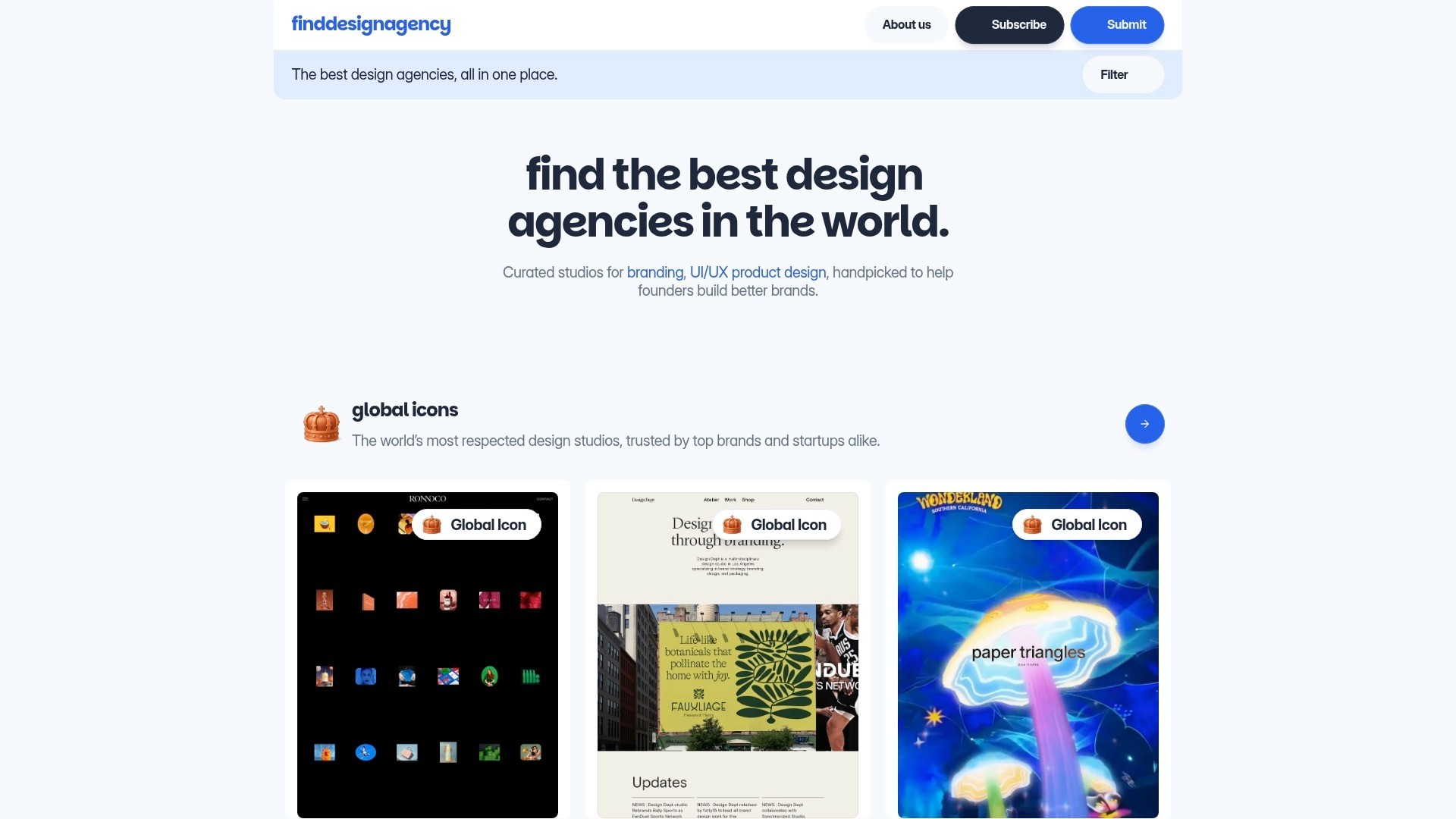
Find Design Agency is a hand-curated directory built for founders who need a creative partner with real startup experience, not just a polished portfolio. Every studio listed is vetted for strategic depth and measurable outcomes, so you can filter by specialization, from branding to digital design, and by budget and location, and land on a shortlist that actually fits your stage of company. Start your search on Find Design Agency and compare agencies built for the problem you actually have.
FAQ
What are the key benefits of hiring a creative agency for startups?
A creative agency gives startups access to specialized, multidisciplinary teams that can differentiate a brand and sharpen communication faster than building that capability internally. The strongest agencies combine strategic insight with design execution to address complex positioning problems, not just visual output.
How does the creative process work within an agency?
Most agencies follow a structured workflow: discovery, brief development, ideation, and iterative rounds of refinement. This process keeps the final output tied to the startup's actual goals instead of drifting toward whatever looks good in isolation.
What types of services do creative agencies provide to tech-driven startups?
Creative agencies typically offer brand strategy, digital design, user experience mapping, market positioning, and messaging development. Together, these services help a startup build a coherent brand presence instead of a collection of disconnected assets.
What should startups consider when selecting a creative agency?
Look at the agency's portfolio for evidence of strategic thinking and measurable impact, not just aesthetics, and confirm they have real experience with startups facing constraints similar to yours. Understanding how they handle feedback and measure success matters as much as the work itself.
Recommended
Globally Top Rated Texas Design Agencies | Jan 2026 | Find Design Agency
Top Rated Award Winning Branding Design Agencies | Jan 2026 | Find Design Agency
Award Winning and Best Design Agencies in Colorado | Jan 2026 | Find Design Agency
Top Rated Florida Design Agencies | Jan 2026 | Miami, Orlando & More | Find Design Agency
More articles you might find useful
Load More


Load More