How to Know When Your Business Is Ready to Hire a Design Agency
Discover how to know when your business is ready to hire a design agency. Uncover key signs and prepare for impactful design success!
📆

Your business is ready to hire a design agency when your current design output is actively costing you customers, credibility, or time. That threshold is more specific than most founders realize, and crossing it without preparation leads to wasted budgets and misaligned outcomes. Knowing the indicators of design readiness before you make the call separates founders who get real results from agencies from those who end up frustrated. This article breaks down the exact signals, budget benchmarks, and preparation steps that tell you whether now is the right time.
The concrete signals to watch for
Design readiness is the point at which your business needs exceed what internal tools, freelancers, or DIY solutions can deliver. McKinsey's own research on the business value of design found that top-quartile design-led companies posted 32 percentage points higher revenue growth and 56 percentage points higher shareholder returns than their peers over five years. The decision to hire isn't cosmetic. It's a growth lever with real numbers behind it.
The clearest signs you need a professional design partner include:
Inconsistent branding across channels. Your website, pitch deck, and social profiles look like they were made by three different companies. Customers notice this before you do.
Your product quality outpaces your visual identity. If what you sell is genuinely good but your design signals otherwise, you're losing trust at the first impression.
You're rebranding or launching a new product line. These moments require specialized expertise in brand architecture, not just a logo refresh.
Design tasks are pulling you away from core work. When a founder spends hours in Canva instead of talking to customers, the opportunity cost is real.
Marketing materials are inconsistent enough to hurt recognition. Inconsistent collateral across campaigns erodes the brand recall you're trying to build.
You need a scalable design system, not a one-off asset. A logo is a file. A design system is infrastructure, and infrastructure is what an agency is built to deliver.
The last point is where the freelancer-versus-agency question becomes concrete. A freelancer solves a task. An agency solves a problem across your entire funnel. If your needs are isolated, a freelancer may be sufficient. If you need brand consistency, UX improvements, and marketing collateral working together, you need an agency.
Pro Tip: Ask yourself whether your current design output would embarrass you in a room with your ideal customer. If the answer is yes, that's your signal.
How to prepare your business before reaching out
Reaching out to an agency before you have clarity on your own goals is the fastest way to waste everyone's time, including yours. Preparation isn't bureaucratic. It's what separates a productive agency relationship from a frustrating one.
Define your project before you describe it
Start with three things: what you want to achieve, what success looks like in measurable terms, and what your timeline requires. "We need a rebrand" is not a brief. "We're repositioning from B2C to B2B and need a brand identity that communicates enterprise credibility by Q3" is a brief. The more specific your inputs, the more accurate the agency's proposal and pricing will be.
Know your brand positioning and have customer insights ready to share. Founders need to provide clear positioning and customer access for agencies to do their best work. An agency that doesn't ask for these inputs during discovery is a red flag, not a sign of efficiency.
How to shortlist and evaluate agencies effectively
Identify your primary need: branding, UX/UI, marketing collateral, or a combination.
Shortlist three to five agencies for comparison. Fewer than three limits your perspective. More than five creates decision fatigue.
Write a clear, written brief before making contact. Send the same brief to every agency so you can compare responses fairly.
Ask each agency about their process, not just their portfolio. How do they handle revisions? Who's your day-to-day contact? What does their feedback loop look like?
Ask for case studies that show business outcomes, not just visual deliverables.
Watch for agencies that lead with unsolicited design concepts during early conversations. Agencies that present concepts before diagnosing your needs are prioritizing style over strategy. The best agencies ask hard questions first and show work second.
You can also filter by specialization. If your primary need is UX, look at top UI/UX design agencies specifically rather than generalist studios. If branding is the priority, award-winning branding agencies with startup experience will be a better fit than full-service digital agencies.
Common mistakes founders make when hiring a design agency
Most hiring mistakes are predictable. Knowing them in advance is the only protection against them.
Choosing based on portfolio aesthetics alone. A beautiful portfolio proves taste, not process. Ask how they manage scope changes and what happens when a direction isn't working; that's a stronger predictor of project success than visual polish.
Underestimating your own time commitment. Agencies aren't set-and-forget vendors. You'll need to attend briefings, review work, provide feedback, and make decisions. Founders who treat agency work as fully delegated end up with outputs that don't reflect their business.
Over- or under-budgeting without market context. Spending $800 on a full brand identity from a budget platform and spending $200,000 on a boutique agency for a seed-stage startup are both mismatches. Calibrate to your stage and scope.
Not verifying who actually works on your account. Some agencies win business with senior talent and deliver with junior staff. Ask directly who'll be on your project and whether that team is consistent throughout the engagement.
The biggest mistake I see founders make is hiring an agency to solve a problem they haven't yet defined. The agency can't define it for you. That work has to come first, before the first call, not during it.
Falling for unsolicited design concepts is a specific trap worth naming. An agency that sends you a logo or mockup before you've signed anything is showing you what they want to make, not what your business needs. Effective agencies diagnose business goals first and present concepts only after they understand the problem.
Key takeaways
Your business is ready to hire a design agency when your visual output is limiting growth, your team lacks the capacity or specialization to fix it, and you have a defined project scope and realistic budget to bring to the conversation.
Point | Details |
|---|---|
Readiness signals | Inconsistent branding, lost customer trust, or design tasks consuming founder time are clear triggers. |
Budget as a fit signal | Share your budget openly with agencies to filter mismatches before investing time in proposals. |
Preparation before outreach | Write a specific brief with goals, timeline, and success metrics before contacting any agency. |
Shortlist discipline | Compare three to five agencies using the same brief to make fair, structured decisions. |
Process over portfolio | Evaluate agencies on workflow transparency and communication cadence, not visual style alone. |
What I've learned about timing this decision right
The founders who get the most from design agencies aren't always the ones with the biggest budgets. They're the ones who show up prepared. Watching early-stage companies navigate this decision, the pattern is consistent: founders who define what success looks like before the first agency call get better work, faster, and with fewer revisions.
There's a version of this decision that gets made too early. A founder raises a small round, feels the pressure to look credible, and hires a prestigious agency before they have product-market fit or a clear customer. The result is a beautiful brand built on an unstable foundation. The rebrand happens 18 months later anyway.
There's also a version made too late. The product is strong, the customers are there, but the brand looks like a beta. Sales cycles run longer than they should because the visual identity signals immaturity. Competitors with weaker products win deals because they look more established.
The honest answer is that readiness isn't about hitting a revenue threshold or a headcount number. It's about having enough clarity on your customer, your positioning, and your goals that an agency can do something meaningful with what you give them. If you can't answer "who is this for and what do we want them to feel," you're not ready yet. When you can answer that clearly, you are.
- Arnob
Find your right design partner with Find Design Agency
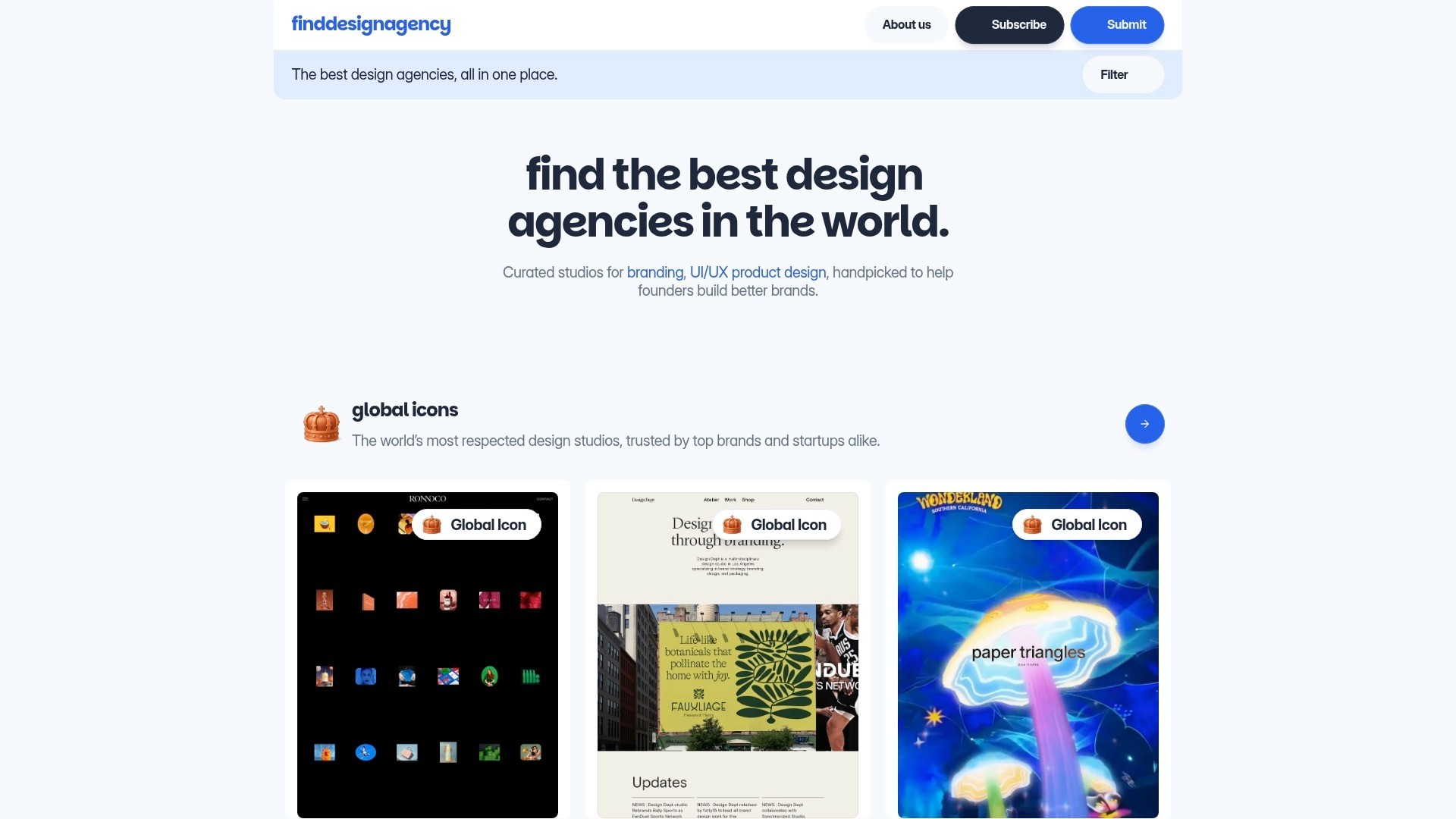
Find Design Agency is a hand-curated directory of the world's best design studios, built specifically for founders and startups who want to build with taste and clarity. Every studio in the directory is vetted for quality, process transparency, and specialization fit. You can browse by location, from design agencies in New York to studios in Dubai and Auckland, or filter by specialization to find agencies that match your exact project needs. Studios like Orizon Design represent the kind of strategic, startup-focused partners the directory is built to surface. When you're ready to move from evaluation to action, Find Design Agency is where the shortlist starts.
FAQ
What are the main signs it's time to hire a design agency?
The clearest signs include inconsistent branding across channels, a visual identity that no longer reflects your product quality, and design work consuming time you should be spending on core business activities. If your marketing materials are hurting customer recognition rather than building it, that's a direct signal.
How much should an early-stage startup budget for a design agency?
Project-based branding engagements for startups typically range from $5,000 to $50,000 depending on scope and agency size, while monthly retainers generally start around $3,000. Sharing your budget openly with agencies from the first conversation helps filter mismatches and speeds up the selection process.
Should I hire a design agency or a freelancer?
Hire a freelancer for isolated, well-defined tasks. Hire a design agency when you need brand consistency, UX improvements, and marketing collateral working together as a system. An agency scales with you past one-off visual fixes in a way a single freelancer usually can't.
How do I evaluate a design agency before hiring?
Ask about their process, not just their portfolio. Request case studies that show business outcomes, confirm who'll work on your account day-to-day, and send the same written brief to every agency you consider. Process transparency and communication cadence predict project success more reliably than portfolio style.
How many agencies should I shortlist before making a decision?
Shortlist between three and five agencies. Fewer than three limits meaningful comparison, and more than five creates decision fatigue that leads to worse choices. Use the same written brief for every agency so you can evaluate responses on equal terms.
Recommended
More articles you might find useful
Load More


Load More